
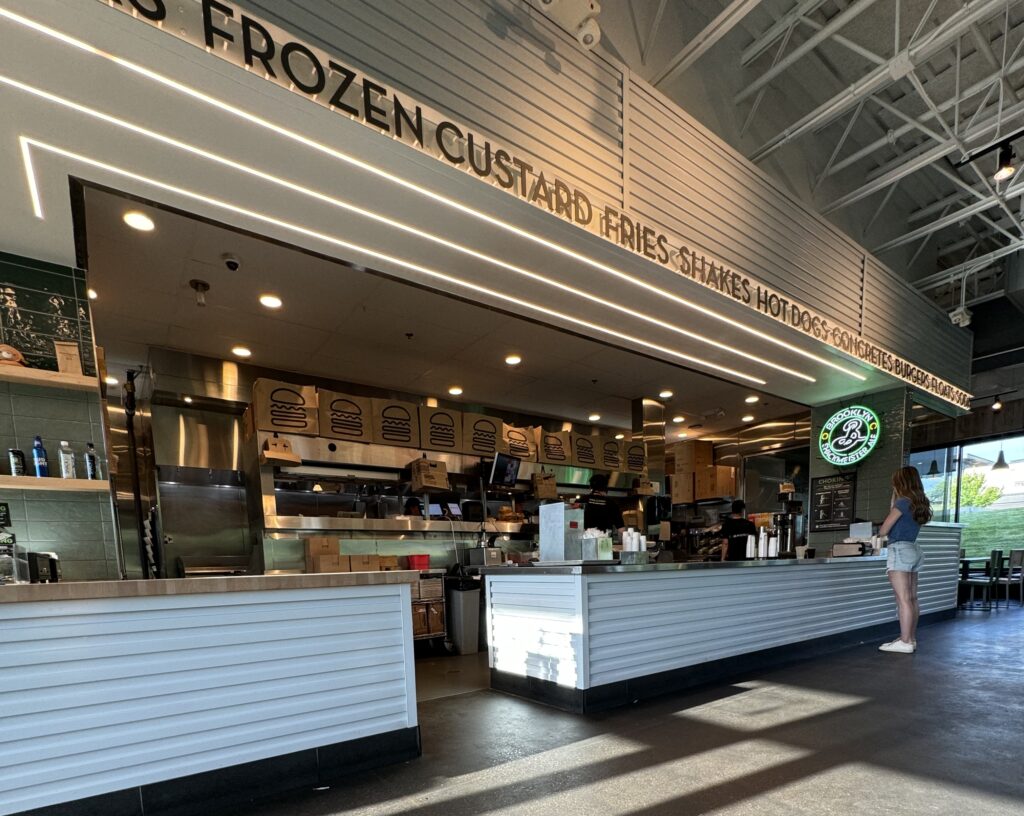
I’ve developed a complicated relationship with Shake Shack, which is probably exactly what they want. These kind of relationships are tense, but strong. The place occupies that peculiar tier of burger joints that emerged sometime in the last decade or so – not quite McDonald’s, definitely not a $40-burger steakhouse, but hovering in that artfully designed middle ground where you pay $15 for a burger and feel vaguely sophisticated about it.
The origin story is charming enough: hot dog cart in Madison Square Park in 2001, permanent kiosk by 2004, now over 400 locations spanning the globe. That trajectory – from humble beginnings to international burger empire – should make me skeptical. And yet, when I bite into their Veggie Shack, I understand exactly how they pulled it off.
This burger is legitimately good. Not “good for fast food” or “surprisingly decent for a chain” – actually good. It looks and tastes far beyond what you’d expect to find at a place with 250+ U.S. locations. When I’m standing there at the counter (or more accurately, staring at an iPad, which we’ll get to), I remember why I keep coming back.
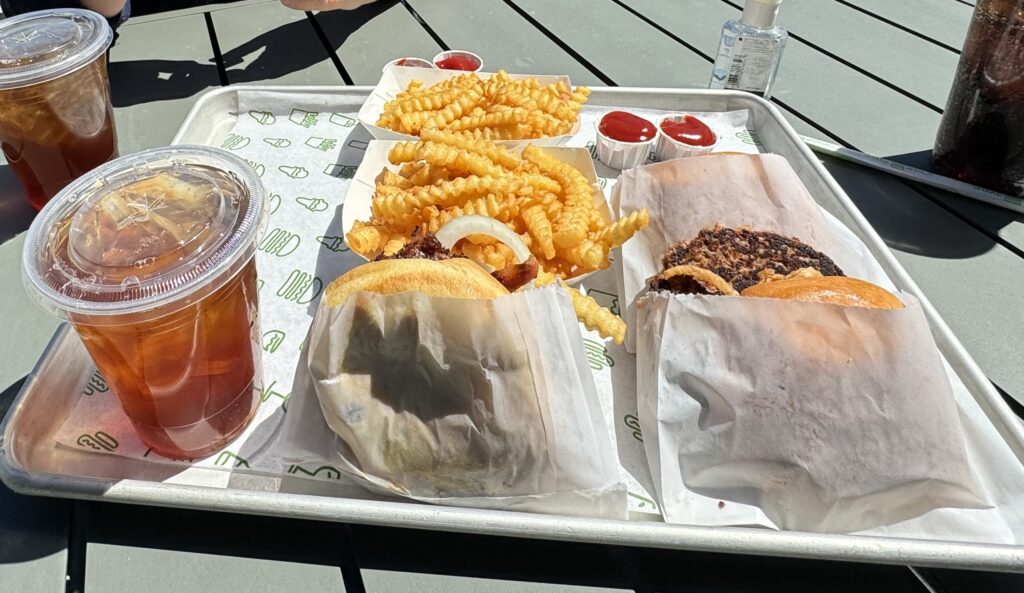
Then I look at the nutrition information and remember why I also call it Salt Shack. That Veggie Shack patty? 760mg of sodium. As prepared on the menu – a single burger – you’re looking at 1,630mg. The double clocks in at a genuinely impressive 2,730mg of sodium. Everything is covered in salt. Everything. And because you can’t customize your order – they say on their FAQ that they find customization boxes just cause confusion – you’re stuck with whatever level of sodium they’ve decided is appropriate, which appears to be “all of it.”
The vegan situation here requires a certain flexibility of spirit.
Different people draw different lines about what they’re willing to accept – shared cooking surfaces, potential cross-contamination, the philosophical implications of supporting a burger chain.
Shake Shack offers two meatless options: the Shroom Burger (a portobello, but it’s stuffed with muenster and cheddar, battered and deep-fried), which is vegetarian but decidedly not vegan, and the Veggie Shack, which can be made vegan if you’re willing to make some compromises. Remove the cheese.
- Remove the Shack Sauce (it has egg).
- Remove the crispy fried onions (they have milk).
- Swap out the potato roll (also milk) for either a lettuce wrap or a gluten-free bun, which ironically has twice the sodium of the potato roll.
Because of course it does.
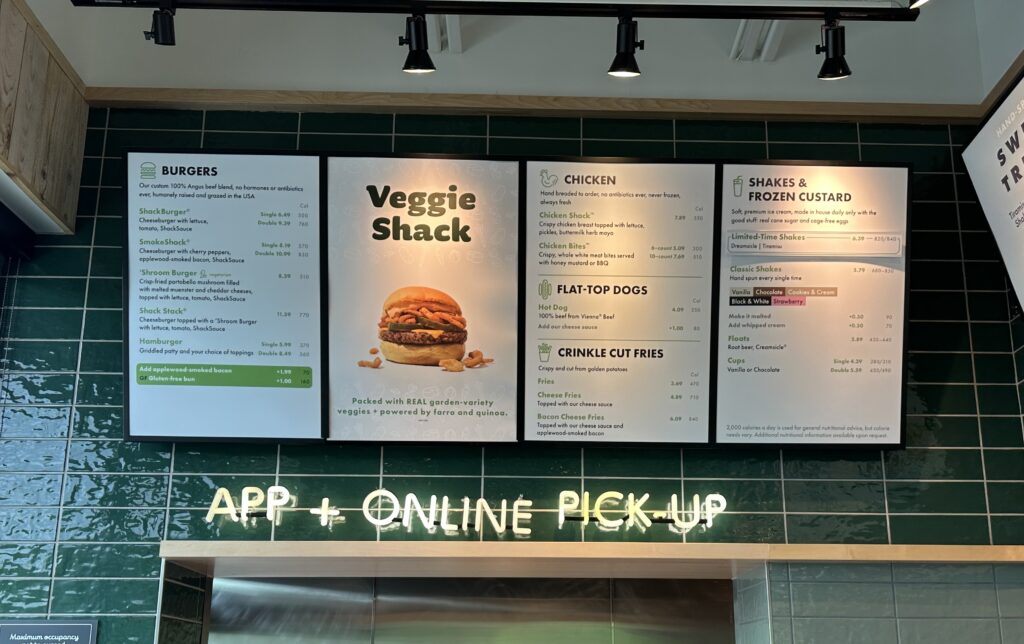
The physical spaces are pleasant enough – green color scheme, decent lighting, spacious layout. No complaints there. The service is almost entirely app-based, which sounds convenient until you actually try to use their app. (You can change the language. Why can you change the language? Who needs this feature?) I usually just use the website, though even that insists on making me log in rather than ordering as a guest, and the whole location-selection-before-menu-access dance makes total sense – availability varies by location – but it feels unnecessarily complicated.
But my real issue – the thing that genuinely baffles me – is the packaging.
Every restaurant has its schtick. Shake Shack’s appears to be cookie sheets with waxed paper, which works fine for dine-in. You get your burger in a little paper wrapper, fries in a paper boat, everything on a tray. From a waste perspective, it’s actually admirable. The problem is carryout.
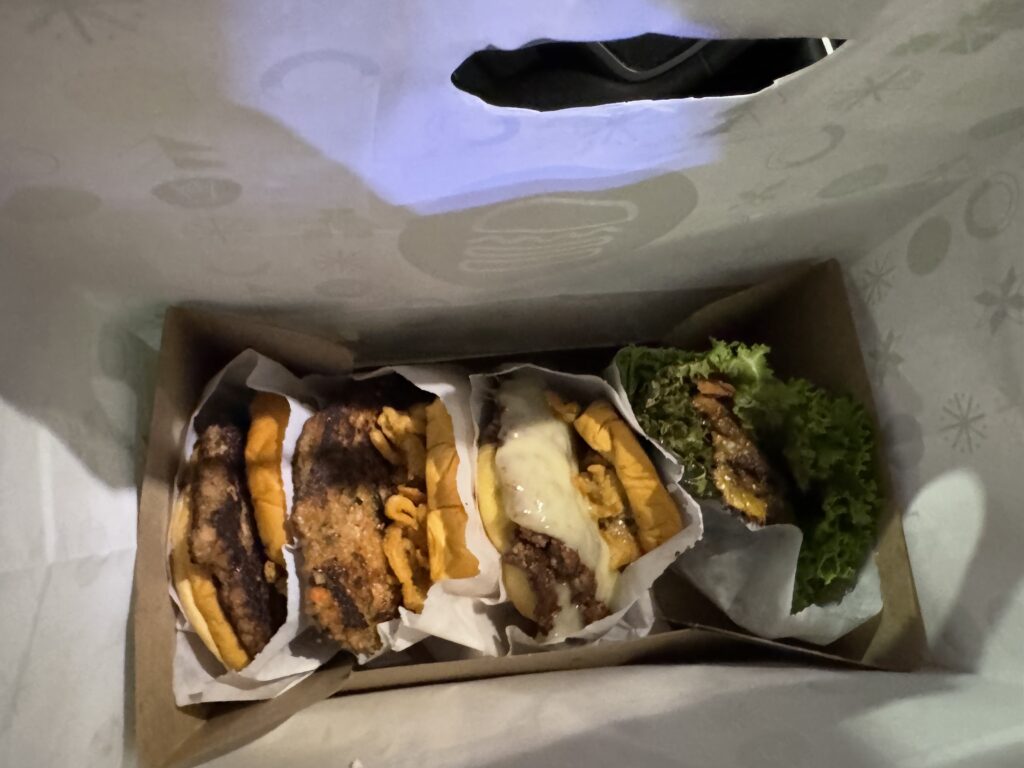
They use these large paper sacks – maybe 12 to 14 inches wide, 10 inches tall – and they put a cardboard “boat” in the bottom, presumably to provide structure. Then they stand the burgers upright in their open-ended paper wrappers, stacking more burgers or fries on top or to the side. These wrappers provide no structure. The burgers get compressed. More importantly, they lose heat with alarming speed. By the time you get wherever you’re going, your food is “just warm” at best.
I once shared this feedback with them. I received a very polite response explaining that they’d…
“…recently updated our To Go order standards to no longer include individual containers for each item, as part of our efforts to reduce waste.”
Which would be noble, except that putting that giant cardboard boat in every single bag – regardless of order size – instead of using the thin clamshell containers they already have actually produces more waste. And here’s the kicker: they do use clamshells for Uber Eats orders. Just not for their own carryout.
The place sits in the same category as In-N-Out, Whataburger, Five Guys – brands that inspire devotion through some combination of quality, consistency, and marketing genius. Unlike the rest, they actually have a vegetarian / vegan option – one with a patty that is, because technically In-N-Out has a vegan burger, but it’s unlike anything you’ve ever seen. A bun, with all of the veggies you’d normally get, and no patty of any kind. I am not kidding. So I’d say the value proposition is decent but not stellar. You’re getting a delicious albeit salty plant-based burger, but what you’re really paying for, I think, is the experience of buying into a somewhat sensationalized brand, along with the aesthetic comfort of the space itself. The actual service – staff who rarely acknowledge you unless you specifically seek them out – isn’t particularly better than anywhere else.
Still, I keep going back.
That Veggie Shack is just too good, even if it arrives lukewarm in a collapsed paper wrapper, even if I have to navigate a clunky website to order it, even if my sodium intake for the day is essentially decided the moment I walk through their green-accented doors. Some contradictions, it turns out, are worth living with.
Please select a review.